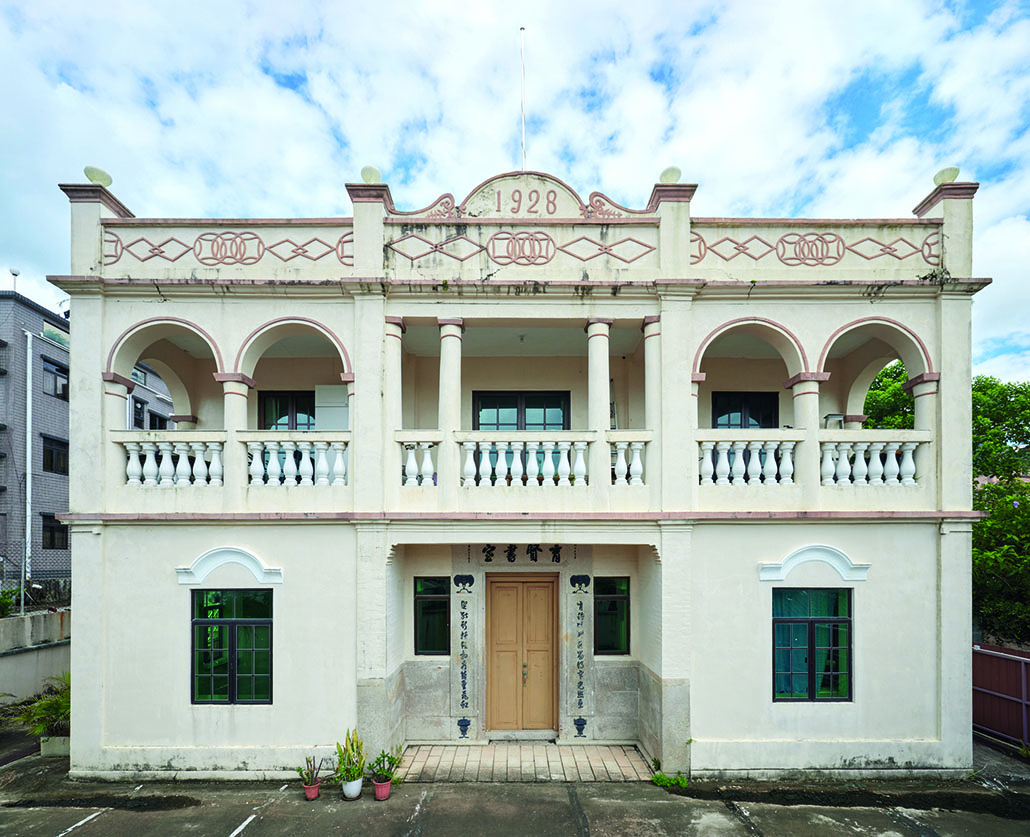
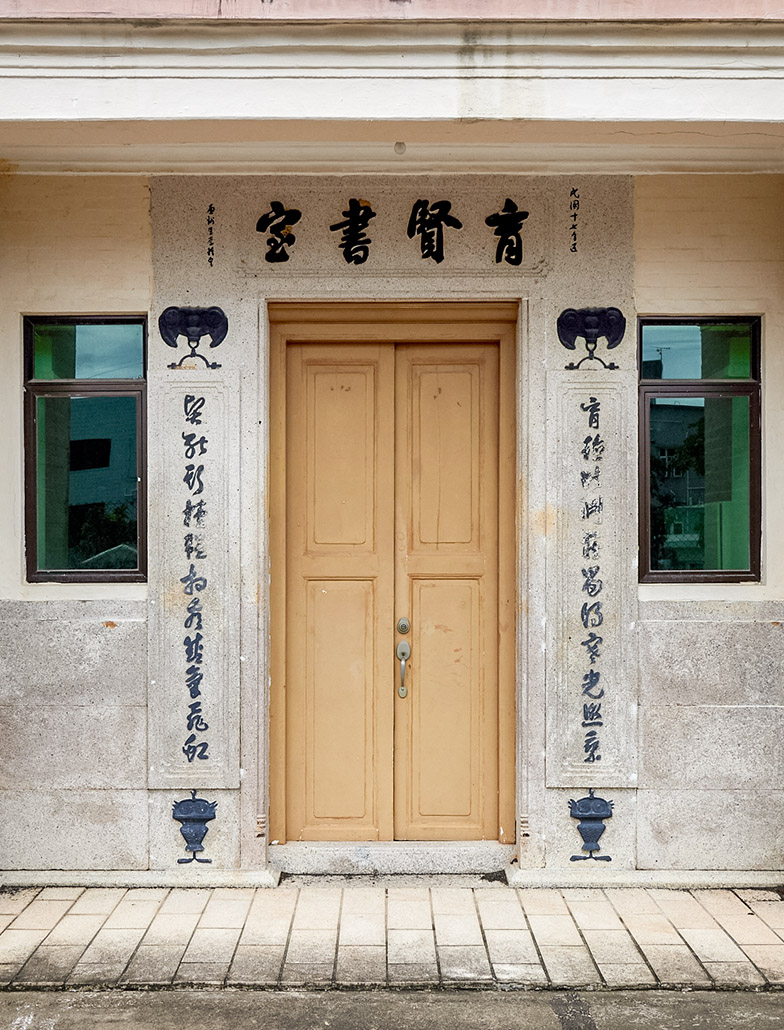
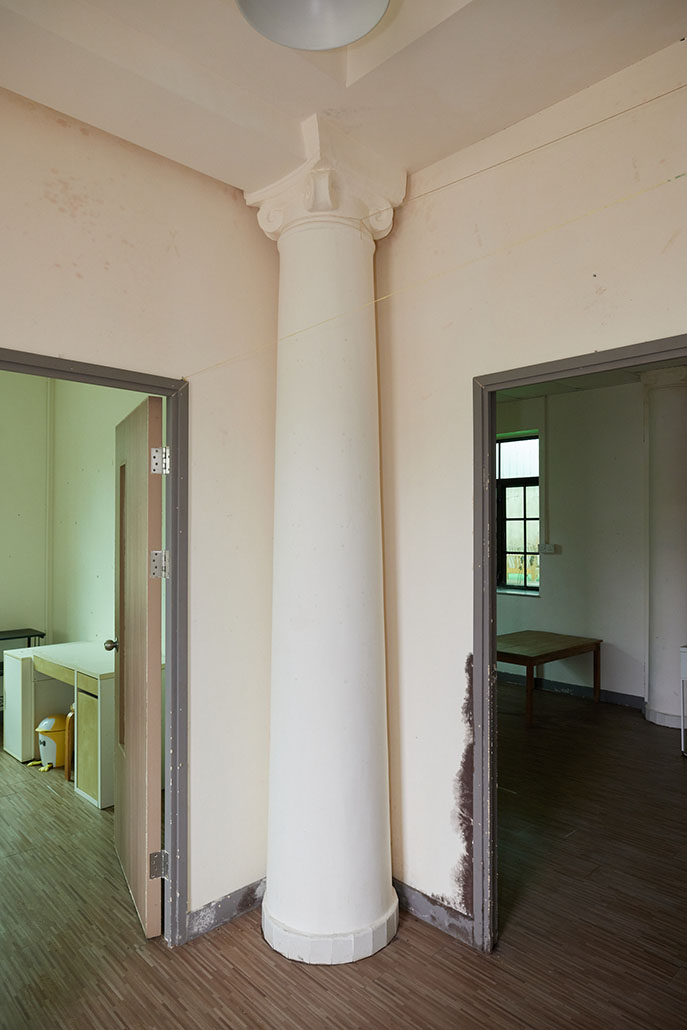
Yuk Yin Study Hall in Sha Kok Mei village, Sai Kung, was built in 1928 with the land being provided by the Wei clan and funding from villagers abroad. Before the War of Resistance against Japanese Aggression, it housed a Bok Bok Chai study hall. The walls of the study hall are constructed with grey bricks, and it has a forecourt and a backyard. On the lintel of the main entrance are the words Minguo Shiqinian Jian (built in the seventeenth year of the Republican Era), along with the inscription “1928” on the pediment of the upper part of the exterior wall, indicating the year of construction. The first-floor balcony is adorned with Western-style round columns and arches, as well as vase-shaped balustrades, representing a fusion of Chinese and Western architectural features.
After the Japanese troops invaded Hong Kong and extended their occupied territory in South China in 1941, in February 1942, the Guangdong People’s Anti-Japanese Guerrilla Force established the Hong Kong-Kowloon Brigade (the name was later changed in Chinese) in Wong Mo Ying Tsuen, Sai Kung, with Cai Guoliang as its leader. Most of its members were local residents. The brigade continued its armed resistance against Japan during the Japanese Occupation. In December 1943, the Guangdong People’s Anti-Japanese Guerrilla Force consolidated its resistance forces and renamed itself as the Dongjiang Column.
Since Sai Kung was the base camp of the brigade, Yuk Yin Study Hall was transformed from a typical traditional study hall into one of the key secret resistance bases of the Hong Kong-Kowloon Brigade of the Dongjiang Column to step up the surveillance of the Japanese troops and strengthen connections among members of the guerrilla force. The Hong Kong-Kowloon Brigade was committed to rescuing prominent cultural figures and patriotic democrats who had remained in Hong Kong. It played an important role in Hong Kong’s resistance campaign. The wife of Yu Hanmou, commander of the Seventh Chinese Theatre, stayed briefly in Yuk Yin Study Hall, Sai Kung, before travelling to Shenzhen by sea.
According to the oral history account of Lau Kam-man, the then secretary of the guerrillas in Sai Kung, members of the brigade liked to sing patriotic songs, such as “On Songhua River”, “Eighth Route Army Chorus” and “Dongjiang Column Chorus” in Yuk Yin Study Hall to spread patriotic ideas to the young people and unite the villagers in the resistance campaign. New members were trained to gather intelligence.
Yuk Yin Study Hall bears witness to the invaluable history of the resistance efforts of the Hong Kong-Kowloon Brigade of the Dongjiang Column. In August 1945, a party of armed forces of the Hong Kong-Kowloon Brigade of the Dongjiang Column launched a military operation to try to disarm the Japanese. The next day the Japanese hurriedly made their way to urban Kowloon by sea at night, and the guerrillas took effective control of Sai Kung town. The arms and equipment left by the defeated Japanese forces were taken to Yuk Yin Study Hall for storage, and then sent to the Liaison Hong Kong Office of Dongjiang Column. The study hall was seized by Japanese troops for a short time during the Japanese Occupation. A guerrilla agent living in a village house in opposite to Yuk Yin Study Hall and able to keep the guerrillas well informed of the strength and deployment of the Japanese forces in Sha Kok Mei. It was reopened after Japan’s surrender in 1945 and was subsequently converted into Yuk Yin Primary School with the support of government funding. In 1966, school was relocated to a new building named as Yuk Yin School. From 1971 to 1976, the study hall was used by the Sai Kung branch of Chung Yip Middle School. In recent years, it has been used as a community centre for the villagers.
Opening Hours:
Not open to the public
Address:
No. 1A Sha Kok Mei Second Lane, Sai Kung, New Territories